Creative Intelligence Model
Decoder
Turn any winning ad into a system you can run.
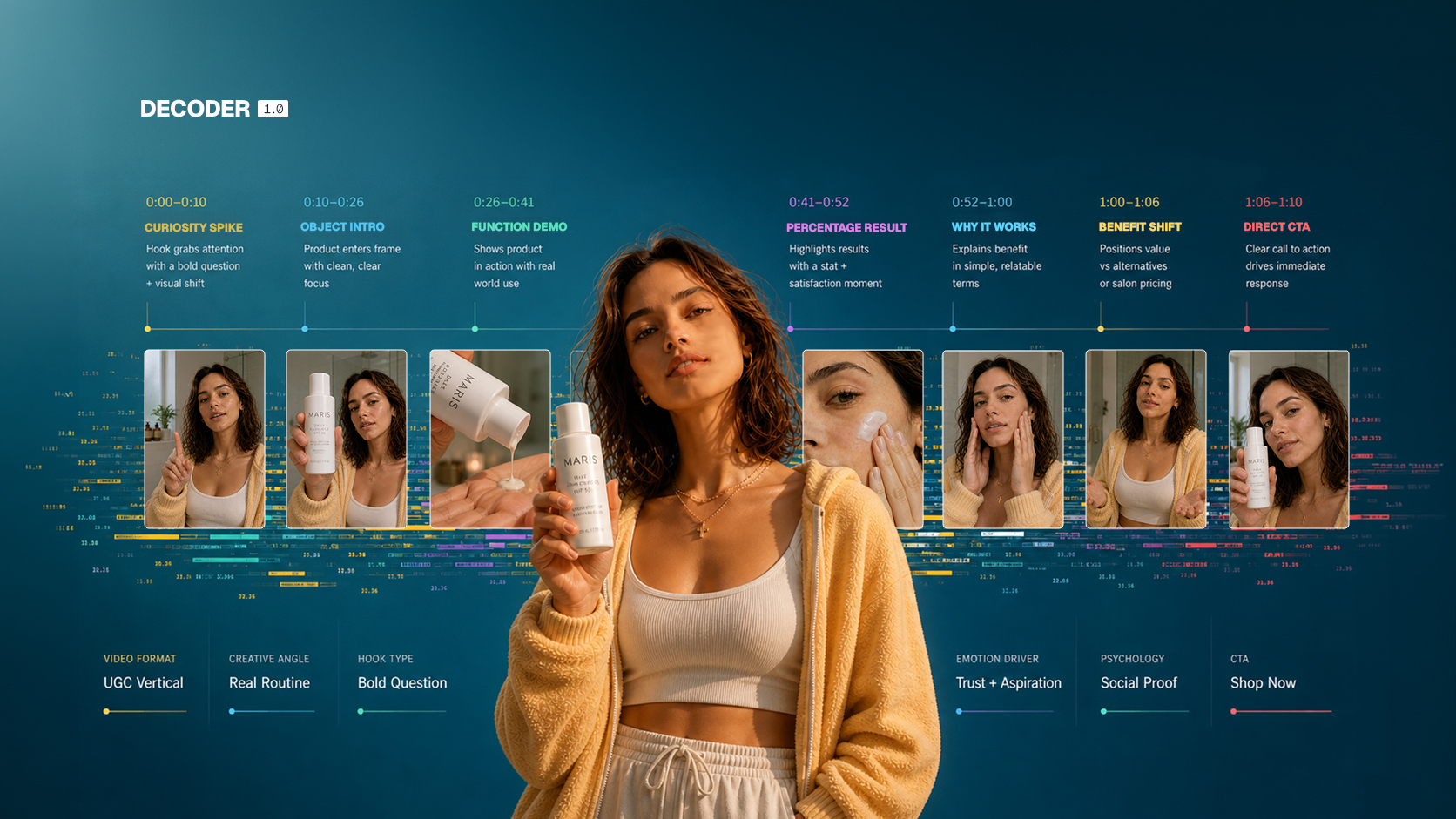
That ad running for 90 days in your vertical? There is a formula underneath it. A hook type that stops the scroll. A beat sequence that builds tension. A psychological architecture that makes the viewer act. You can see all of it. You can use all of it. Decoder extracts the invisible structure behind any winning ad and turns it into a creative system you can rebuild for your brand.
What Decoder sees: The invisible architecture inside every winning ad
- The PatternMap
- Every ad has a structure. Opening, tension, delivery, validation, close. Decoder finds the beat sequence, names each section, and shows you why they appear in that order.
- The hook that stops the scroll
- Decoder identifies the hook type, how long it holds before the viewer decides to stay, and why it works for this specific audience. Named, not guessed.
- The formula you can rebuild
- Format, angle, narrative mode, funnel stage. Not labels you file away. A reusable creative system you can run with your own brand, product, and voice.
- The psychology driving conversion
- Which persuasion principles fire in each section. Where loss aversion kicks in. Where social proof stacks. Where the viewer decides to buy. Named, timed, and mapped.
- The visual playbook
- Every cut, every framing choice, every lighting decision. The director-level production guide you can hand to a creator and say: shoot it like this.
- The layers underneath
- Real ads stack multiple ideas inside a single scene. Decoder separates them. You see each layer independently so you know exactly what to keep, what to cut, and what to steal.
Structure, not surface
Swipe files show you what the ad looks like. Analytics tell you what performed. Neither tells you why the ad works. Decoder does. Which psychological triggers fire, in what order, at what timestamps, and what breaks if you change the sequence.
A swipe file says "save this testimonial ad." Decoder says "this ad opens with an Authority Hook at 0:00, earns credibility through a contrarian claim at 0:03, transitions to a Discovery Moment at 0:08, and closes with an Identity Hook at 0:22 that aligns the product with how the viewer sees themselves."
That is the difference between saving an ad and owning the system behind it.
Every creative decision gets sharper
- Steal the system behind a competitor's best ad. You see an ad running for 90 days. You know it is working. You do not know why. Decoder shows you the formula so you can rebuild it for your brand instead of guessing.
- Find what actually wins in your category. Decode 20 ads in your vertical. See which hook types, formats, and psychology missions keep showing up. Stop copying surfaces. Start running the structures that win.
- Brief creators with the formula, not a screenshot. Instead of "make something like this," hand your team the decoded system. Beat structure, psychology map, visual playbook. The brief writes itself.
- See what you cannot catch by watching. A 30-second ad has 5 structural beats, 12 cuts, and 4 active persuasion mechanics. You will never catch that by watching. Decoder sees it in seconds.
- Decode first, then generate. Before you write the next script, brief the next creator, or generate the next AI video, decode what already worked. That is the difference between prompting from scratch and building from a proven system.
Three surfaces. Same intelligence.
- Run in the Shop
- Full decode interface with video playback, beat timeline, and visual output. Decode history saved to your library. The fastest way to see Decoder work.
- Build with the API
- Embed Decoder into your own tools, dashboards, or creative pipelines. One call, structured output, ready for your stack.
- Install the Skill
- Give Claude the ability to decode ads. Run Decoder inside the AI workspace where you already think, plan, and build.
Turn one ad into an entire system
Decoder takes a single ad and returns the structure behind it. Timing, psychology, sequence, and logic. Not a summary. The actual architecture.
- See exactly why an ad works
- Break any ad into its structural beats
- Extract the formula behind it
- Identify the hook type and why it stops scroll
- Understand how tension is built and resolved
- See what persuasion techniques drive conversion
- Know where the ad wins or loses attention
- Rebuild it for your brand using the same structure
- Brief creators with precision instead of guesswork
- Turn one ad into multiple variations
Then scale it
Decode 50 ads. Decode 100. Turn an entire ad account or competitor library into structured intelligence. The patterns show up fast.
- Find patterns across your winning ads
- Identify your highest-performing formulas
- Understand what consistently drives results
- Compare your ads vs competitors
- Spot gaps in your creative strategy
- See which hooks, angles, and structures scale
- Turn 50-100 ads into a structured playbook
- Build your own "what works" database
- Replace guesswork with evidence-backed decisions
The missing layer: Generation is not the hard part anymore. Knowing what to generate is.
Everyone is connecting Claude to Arcads. Sending scripts to Kling. Generating UGC at scale. The production layer is solved. The problem is they are generating from prompts. Not from proven structure. That is why most AI ads look the same and perform the same. Decoder is the step before generation. Decode what worked first. Then generate from the system, not from scratch.
Winning ad → Decoder → System → Generate
Model card: Decoder 1.0
A creative intelligence model trained on structured ad data. Classifies across 325+ creative dimensions. Produces 50+ structured fields per decode that no general AI model can replicate. Gets stronger with every ad it sees.
- Training data
- 1M+ creative decisions decoded in the structured dataset spanning 22 verticals.
- Classification dimensions
- 325+ total: 28 video types, 68 platform behaviour modes, 25 creative formats, 22 algo intents, 21 marketing angles, 22 behavioural roles, 16 psychology missions, 12 cognitive biases, 100+ beat subtypes, plus 280+ vision taxonomy values (framing, angle, camera, lighting, expression, transitions).
- Per-decode output
- 50+ structured fields: beat sequence with timing, per-beat linguistic DNA (sentence shells, slots, cadence, POV), hook classification, psychology map with behavioural principles, platform mode, formula fingerprint, vision playbook per cut, feature compatibility, structural similarity scoring, and compiled executable framework.
- Decode time
- Under 60 seconds for any video ad up to 120 seconds.
- Evaluation
- Every decode scored across 6 dimensions (pattern_map, beats, formula, psychology, visual_playbook, ad_intel) against golden fixtures. Structural correctness gated at 99%. Creative accuracy tracked per dimension.