Brand Intelligence Model
PowerSource
Turn any brand into a strategic intelligence layer.
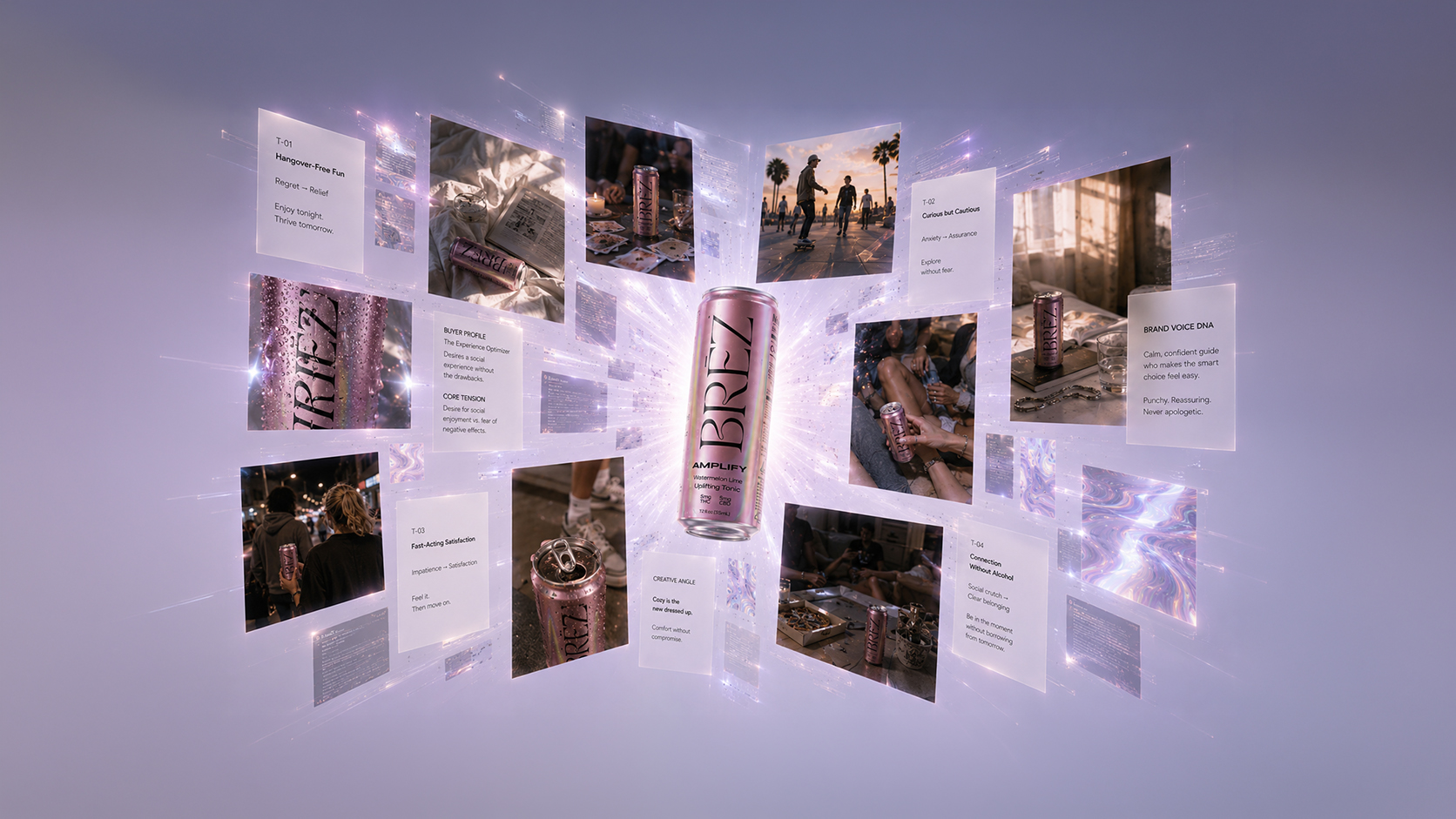
The strategy underneath every brand is invisible until it isn't. The buyer they actually sell to. The tensions their customer feels but never names. The voice their best copy uses without writing it down. The angles their winning ads run on. PowerSource ingests URLs, documents, brand signals, or any combination, and turns them into a single structured intelligence package every Heista tool can brief, script, and ship from.
What PowerSource sees: The strategy underneath every brand
- The buyer profile
- Psychological archetype with the full trigger-search-evaluate-hesitate-convert journey. Primary emotion. Primary friction. Proof stance. The levers that close the sale, named.
- The behavioral tensions
- Every brand's buyer psychology mapped across the behavioral biases that drive purchase decisions. Each tension carries an emotion path, an angle seed, and a 10-word symbolic expression. A clean creative vector for every bias. None overlap.
- The selling points
- Eight to fifteen cross-referenced selling points per brand. Six independent extractors. One synthesised set. Each point typed, scored on emotional and functional weight, and ranked by visual prominence.
- The brand voice
- Personality DNA in three to five sentences. Not tone rules. Not voice guidelines. A read of how the brand actually writes that any writer agent can absorb and run with.
- The creative angles
- 5-8 angle categories with 2-5 seeds each. 10-15 ready-to-use openers built from the buyer profile. 5-10 contradiction pairs. Four independent axes so creative variation is structured, not random.
- The visual identity
- Primary, secondary, and accent colors. Three palette moods: soft, warm, bold. Heading, body, and CTA fonts with closest Google Font match. Hero, lifestyle, and product imagery classified.
Strategy, not summary
Generic AI gives you a website summary. ChatGPT reads the homepage and writes a paragraph. PowerSource gives you the strategy underneath. The buyer the brand actually sells to. The tensions their best ads run on. The voice their copy uses. The angles their next ad should take. Strategy you can ship from.
A summary says "this brand sells comfortable loungewear with a fun, casual tone." PowerSource says "the buyer is a Comfort-Seeker Realist whose core tension is wanting to look effortless without feeling uncomfortable. The unlock is permission to choose comfort without explanation. Lead with peer proof. Anchor angle: cozy is the new dressed up."
That is the difference between describing a brand and owning the system underneath it.
Every creative decision gets sharper
- Onboard a brand in 90 seconds, not eight weeks. Skip the discovery sprint, the workshops, and the 40-page strategy deck. Submit a URL. Get the brand.
- Brief in the buyer's actual language. Hand your team the buyer profile, the tensions, and the contradiction pairs. The brief writes itself.
- Lock the brand voice across every channel. Plug the personality DNA into ChatGPT, Claude, or your writer agents. Voice consistency stops being a vibe.
- Audit any competitor in two minutes. Run their URL. See their buyer, their tensions, their angles, their voice. Know exactly where to attack.
- Build campaigns on psychology, not assumptions. A tension per bias means a clean creative vector for each one. None overlap. None are made up.
Three surfaces. Same brand intelligence.
- Run in the Shop
- Full PowerSource interface with brand profile, tensions, angles, and visual identity rendered. Brand history saved to your library. The fastest way to see PowerSource work.
- Build with the API
- Embed PowerSource into your own tools, agent stacks, or strategy pipelines. One call, structured output, ready for your stack.
- Install the Skill
- Give Claude the ability to extract any brand. Run PowerSource inside the AI workspace where you already think, plan, and build.
Turn one URL into the whole brand
PowerSource takes a single URL and returns the strategy underneath it. Buyer psychology, behavioral tensions, brand voice, creative angles, and visual identity. Not a summary. The actual brand intelligence.
- See exactly who the brand sells to
- Map behavioral tensions, one per bias
- Extract eight to fifteen synthesised selling points
- Capture the personality DNA in three to five sentences
- Pull five to eight angle categories with seeds and openers
- Generate contradiction pairs that stop scroll
- Lift the entire visual system: colors, fonts, hero imagery
- Brief any creator with the buyer's actual psychology
- Plug brand voice into any writer agent or AI workflow
- Run a strategy phase that takes minutes, not months
Then scale it
Extract 50 brands. Extract 500. Turn an entire vertical or competitor set into structured brand intelligence. The patterns show up fast.
- Find patterns across winning brands in your category
- Identify which buyer archetypes dominate the vertical
- Map which tensions repeat across competitors
- Compare your brand vs the field
- Spot positioning gaps nobody is occupying
- See which angles, voices, and visual systems scale
- Turn a category into a structured intelligence library
- Build your own "what works" brand database
- Replace assumptions with evidence-backed positioning
The missing layer: AI generates fast. Knowing what the brand should say is the hard part.
Everyone is plugging Claude into copy tools. Everyone is generating ads, scripts, briefs, and pages with foundation models. The production layer is solved. The problem is they are generating from prompts. Not from brand intelligence. That is why most AI copy sounds the same and lands the same. PowerSource is the layer before generation. Extract the brand first. Then generate from the system, not from scratch.
Brand URL → PowerSource → Brand Intelligence → Generate
Model card: PowerSource 1.0
A brand intelligence model trained on structured brand data. Classifies across 100+ creative dimensions. Produces 500+ structured fields per extraction across fourteen sections. Gets stronger with every brand it sees.
- Training data
- 600,000+ brand decisions extracted across the production dataset. Each extraction averages 4,500+ structured decisions, with the deepest bundles reaching 7,655. Across the production set: 1,800+ buyer tensions identified, 1,800+ selling points extracted, 1,500+ creative angles generated. Spanning fashion, supplements, beauty, SaaS, food and beverage, fitness, and consumer products.
- Classification dimensions
- 100+ total: page types, Jungian brand archetypes, tone classifications, behavioral biases, message sequences, emotional intents, layout biases, CTA intents, proof stances, hero intents, plus selling point typing and dual-weight emotional/functional scoring.
- Per-extraction output
- 500+ structured fields across 14 sections: identity, offer, selling points, brand story, brand style, brand assets, brand voice, buyer profile, tensions, angles, emotional arcs, CTAs, proof assets, narrative direction.
- Extraction time
- 60-90 seconds for any URL. 75-120 seconds with documents. 110-180 seconds for full mode (URL + documents in parallel).
- Evaluation
- Every extraction scored across 6 dimensions (selling_points, buyer_profile, tensions, brand_voice, angles, offer_ctas) against golden fixtures. Structural validation enforced as a deploy gate. Creative accuracy graded by LLM-as-judge.